
PROXIMITY MAIL MARKETING FOR TRADES
Next job, same street.
Snap the finished job. We turn it into a postcard for the 100 nearest neighbors — real proximity, not ZIP codes — landing in mailboxes in about a week. Trackable QR on every card.
No card required · a free demo card, mailed to you · Built in O-H I-O
STEP 1 OF 4
Drop a job site address
We'll find the nearest mailable homes — real data, real addresses, in seconds.
~1 wk
Order to mailbox
100
Nearest homes, every job
1:1
QR tracking per card
$0
Minimums or contracts
Four things nobody else in direct mail is doing.
Built for the way trades actually win work: visible, local, and fast.
01 — Proximity Mail Marketing
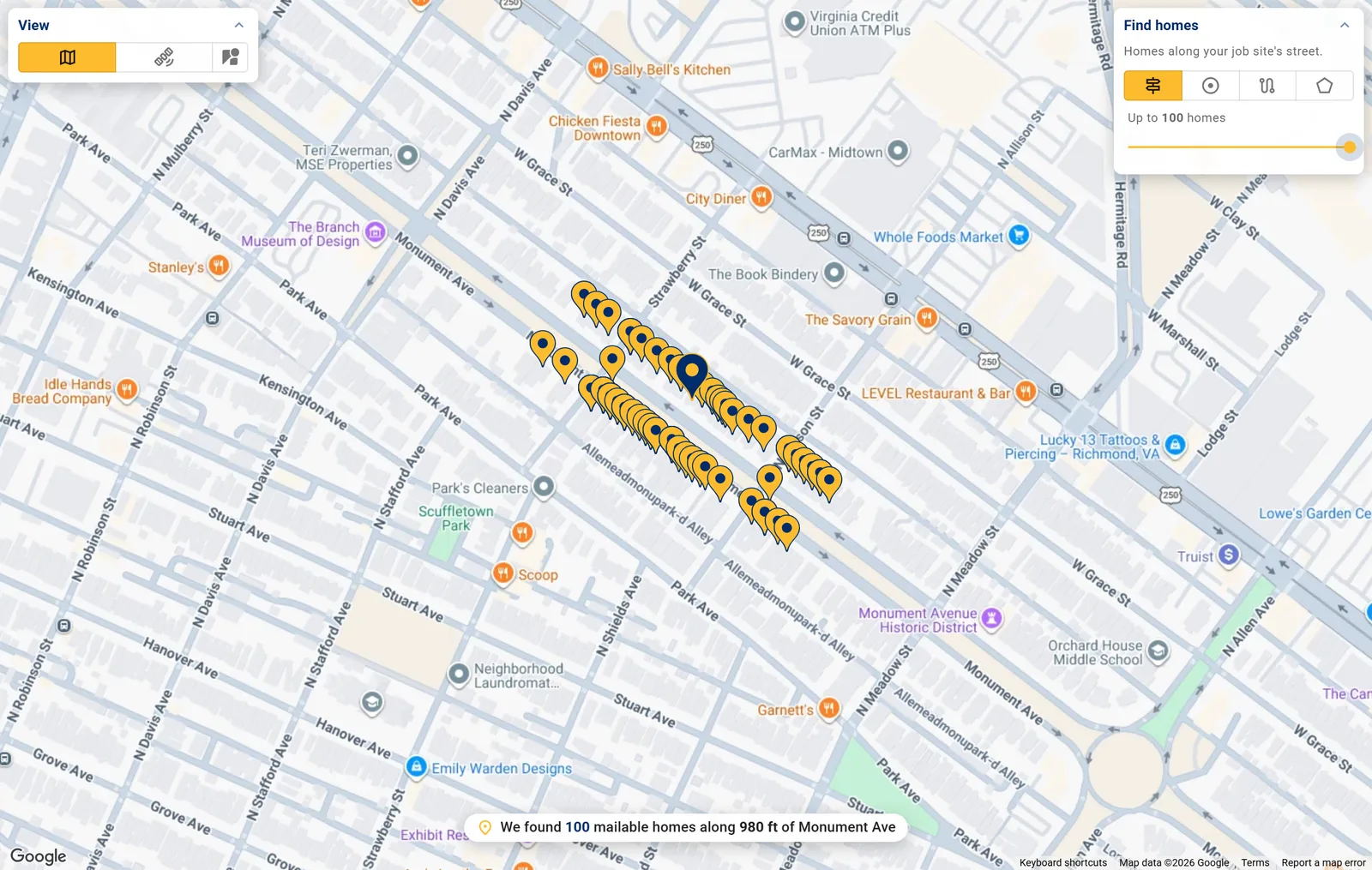
Mail the 100 closest homes — not the whole ZIP code.
Real proximity targeting uses geolocation, not postal boundaries. The house three doors down gets your card. A house five miles away in the same ZIP doesn't. You pay for mail that can actually become your next job. That's proximity mail marketing: targeted by distance from a finished job, not by postal boundary.
02 — Satellite & Street View imagery
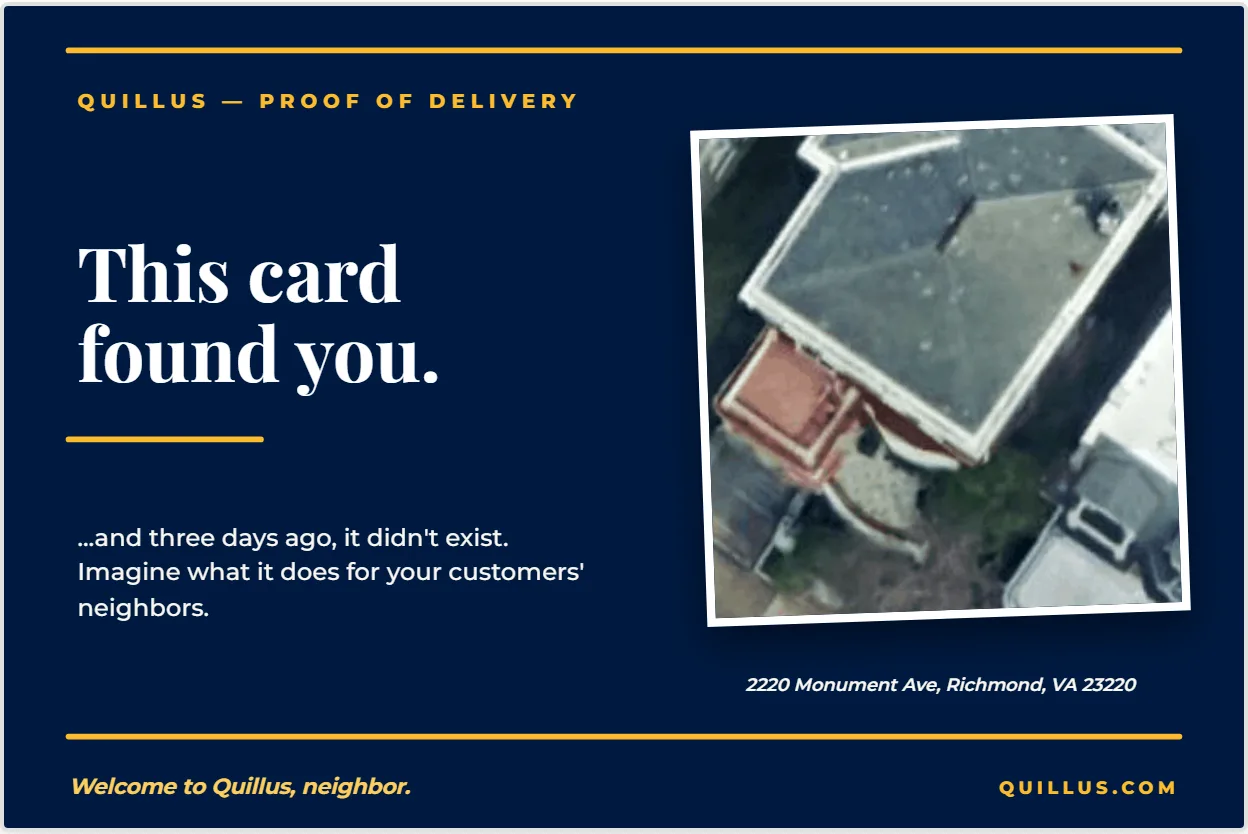
See every roof before you spend a stamp.
Quillus drops automatic satellite imagery onto the back of each card — so your neighbor opens the mailbox to a photo of their own roof, and nobody ignores that. You get the same view inside the app: pan satellite and Street View across the nearby homes, pick out the oldest, most weathered roofs, and ★ favorite the ones worth extra marketing effort.

03 — Fast turnaround
Order Monday. In mailboxes by the weekend — while your sign is still in the yard.
Most direct mail takes weeks to print, days more to enter the mail stream, and arrives long after your customer's neighbors have forgotten you were there. Quillus prints and addresses your cards within a couple of business days and hands them to USPS, where first-class carries them the rest of the way — about a week from order to mailbox.
DAY 1
Order placed
Pick the job site, drop in your photo, hit send.
DAYS 2–3
Printed & shipped
Printed, addressed, and handed to USPS within a couple of business days.
DAYS 4–7
In the mailbox
Delivered first-class — while your yard sign is still up.
04 — Per-card tracking
Know which neighbor scanned which card.
Every postcard carries its own QR code. When a scan happens, you see the address it was mailed to, the time, and the device. And every scan routes the neighbor to your own website to book — your branding, your landing, your lead. No other direct mail tool gives you per-piece attribution at this level.
What's behind the sign-in.
Every image here is a screenshot of the working app, not a mockup. A free sign-in, no card, is the only thing between you and it. It's there for one reason: it's how we keep your neighbors' addresses with the local businesses that actually mail them.
01 — The map
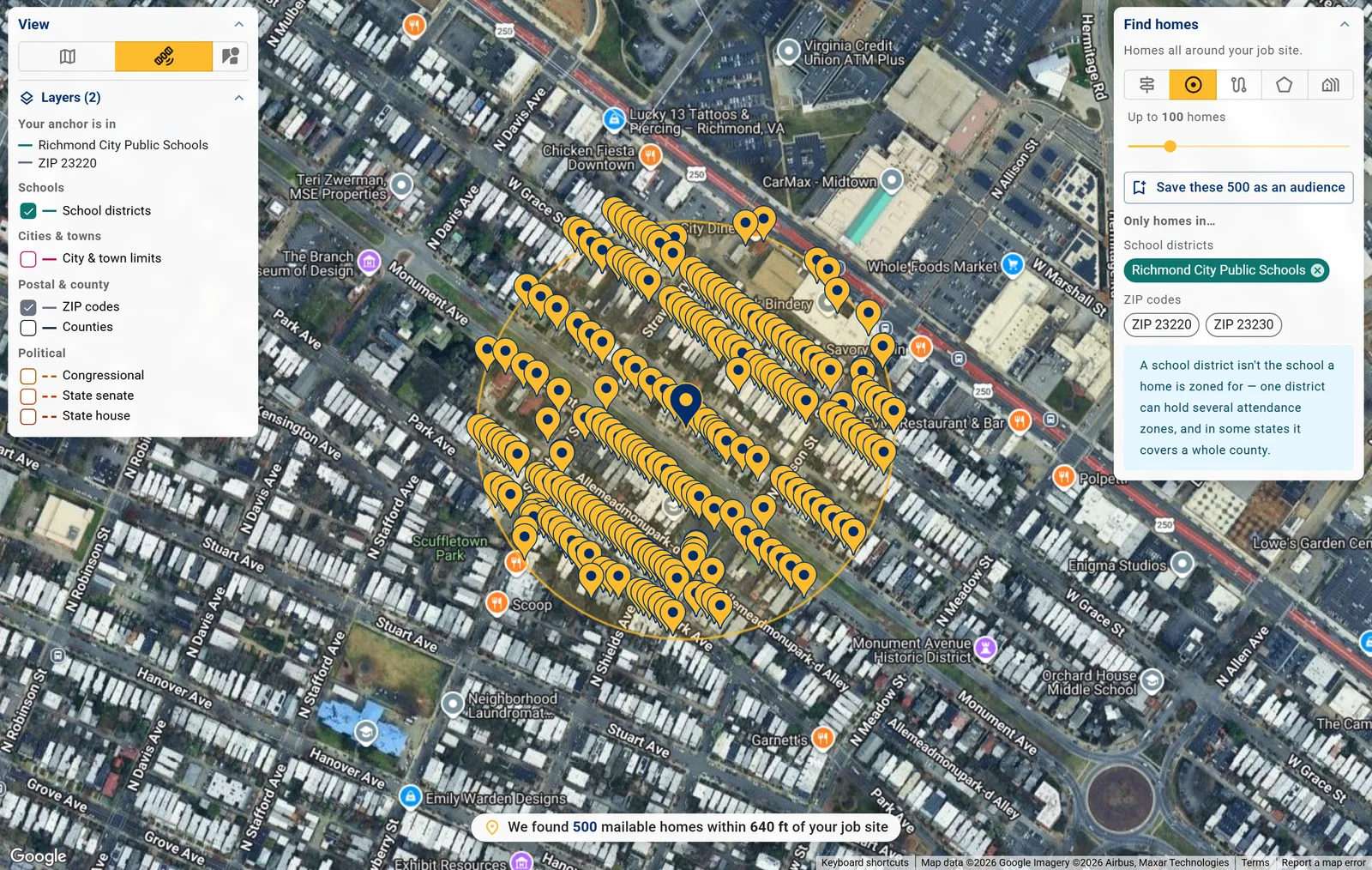
Pick a street, a radius, a route, or a school district.
Drop the job site and the homes around it land on satellite imagery: the same street, a radius around the site, a route you draw, or a neighborhood you name. Turn on a boundary layer and the map tells you which school district, ZIP and town the job sits in. Pick one and the pull narrows to the homes inside it. Slide the count, then save the result as an audience you can mail again.
02 — Property intelligence
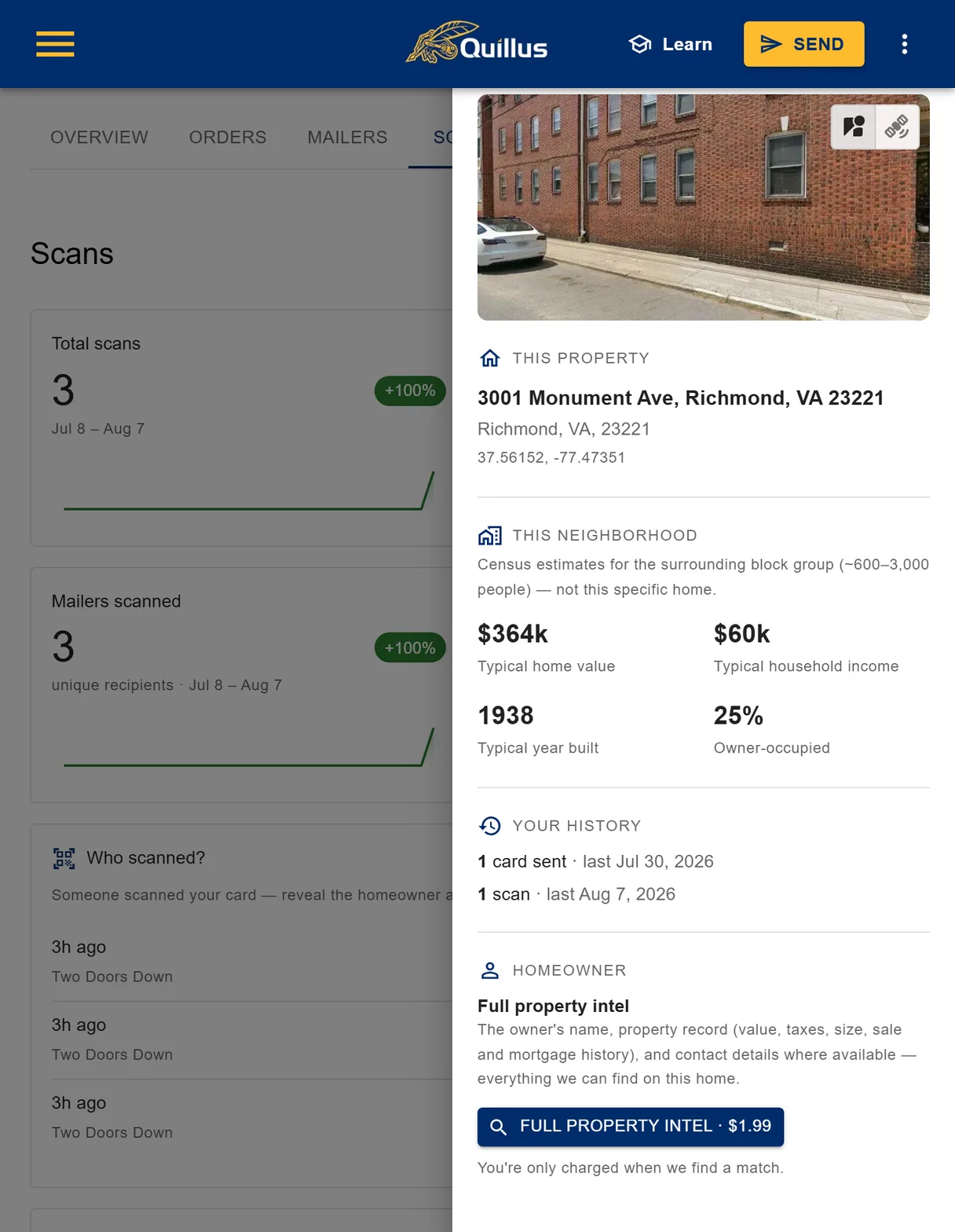
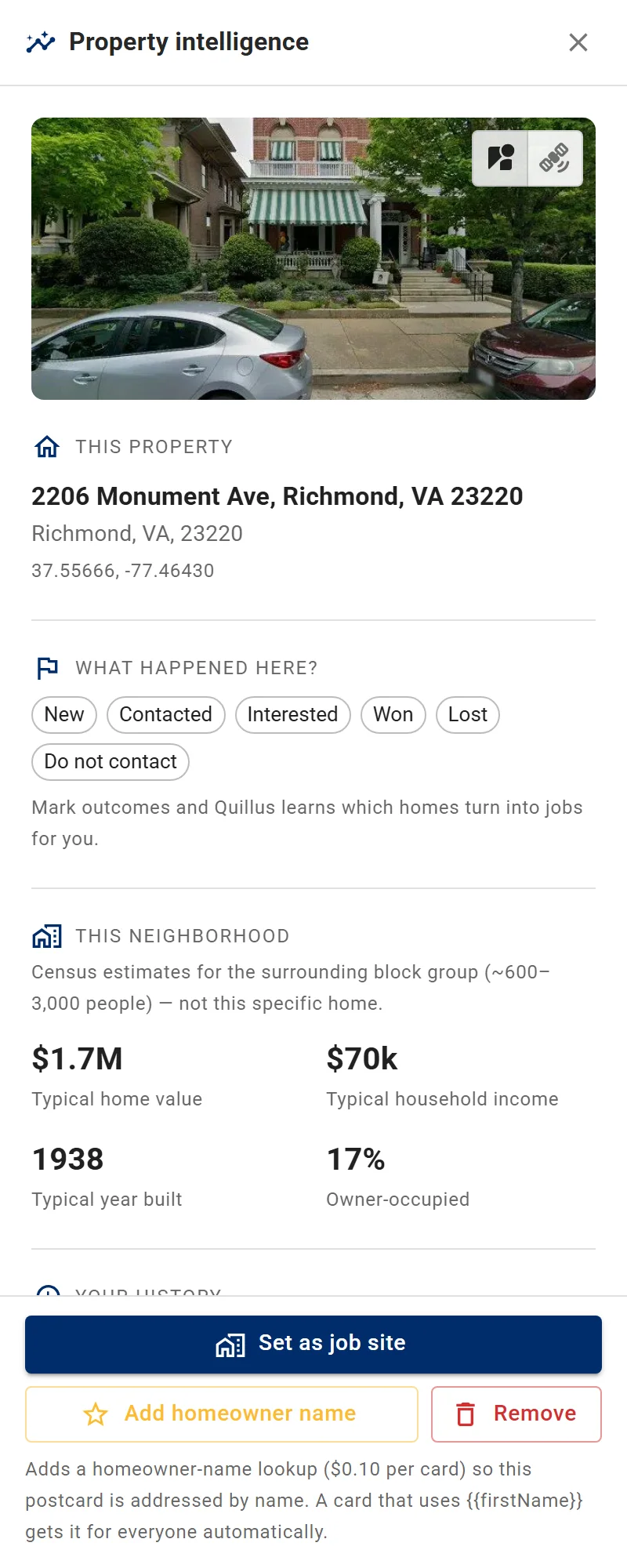
Click any pin. See the house before you spend the stamp.
Every pin opens a Street View look at the home, with Census estimates for its block group: typical home value, household income, year built, owner-occupancy. Mark what happened at that door, contacted, interested, won, and Quillus learns which homes turn into jobs for you. Add the homeowner's name and the card greets them by it.
03 — The designer
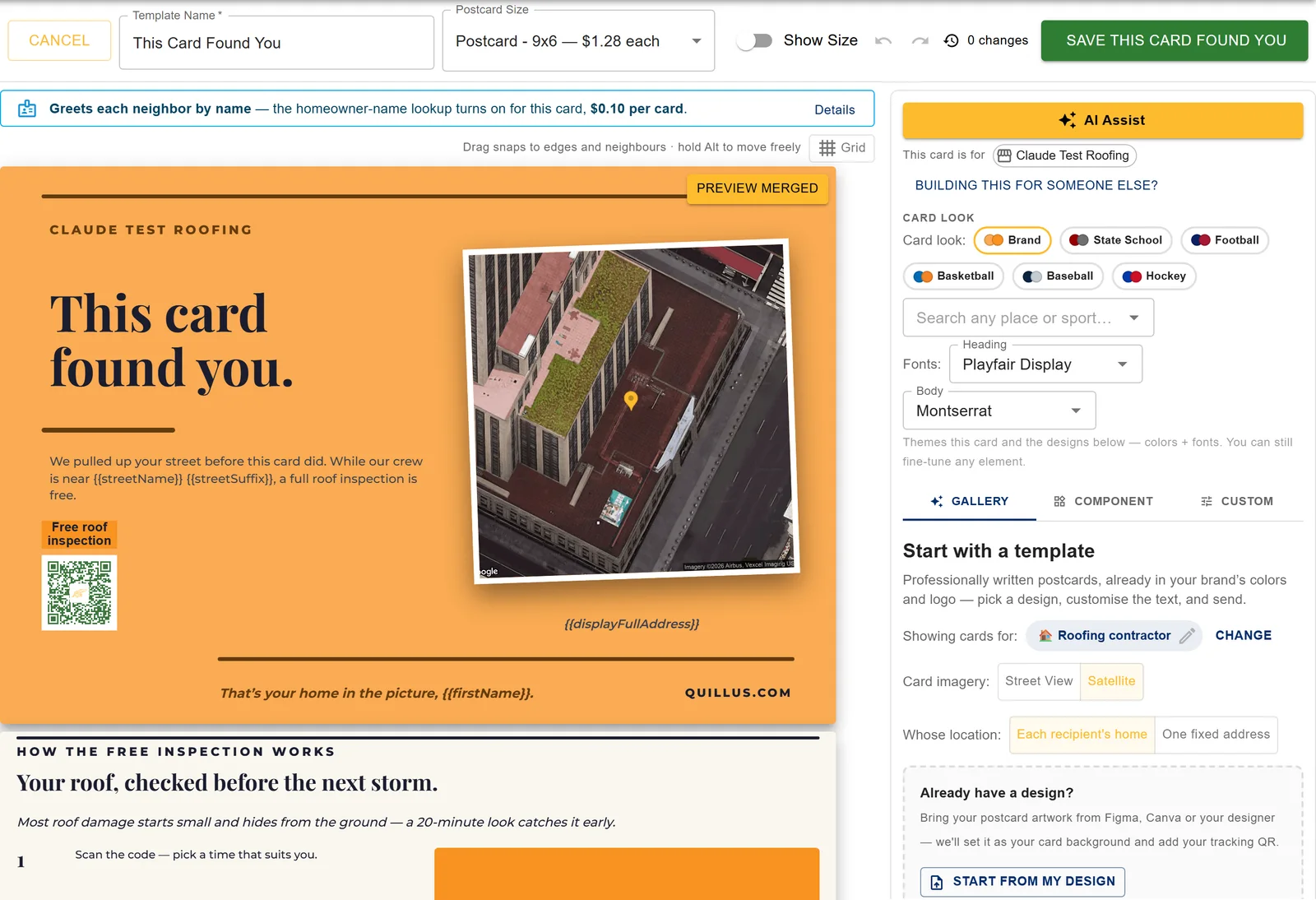
A designer that already knows your brand.
Quillus reads your logo, colors and fonts from your website when you sign up, so every template opens already looking like you. Put each recipient's own street on the card, or a satellite view of their roof. Switch the whole card's look with one chip. Let AI Assist write the lines for your trade. Drags snap to edges and neighbors, and every change sits in the undo history. Already have artwork from Figma or Canva? Start from it.
04 — Speed to lead
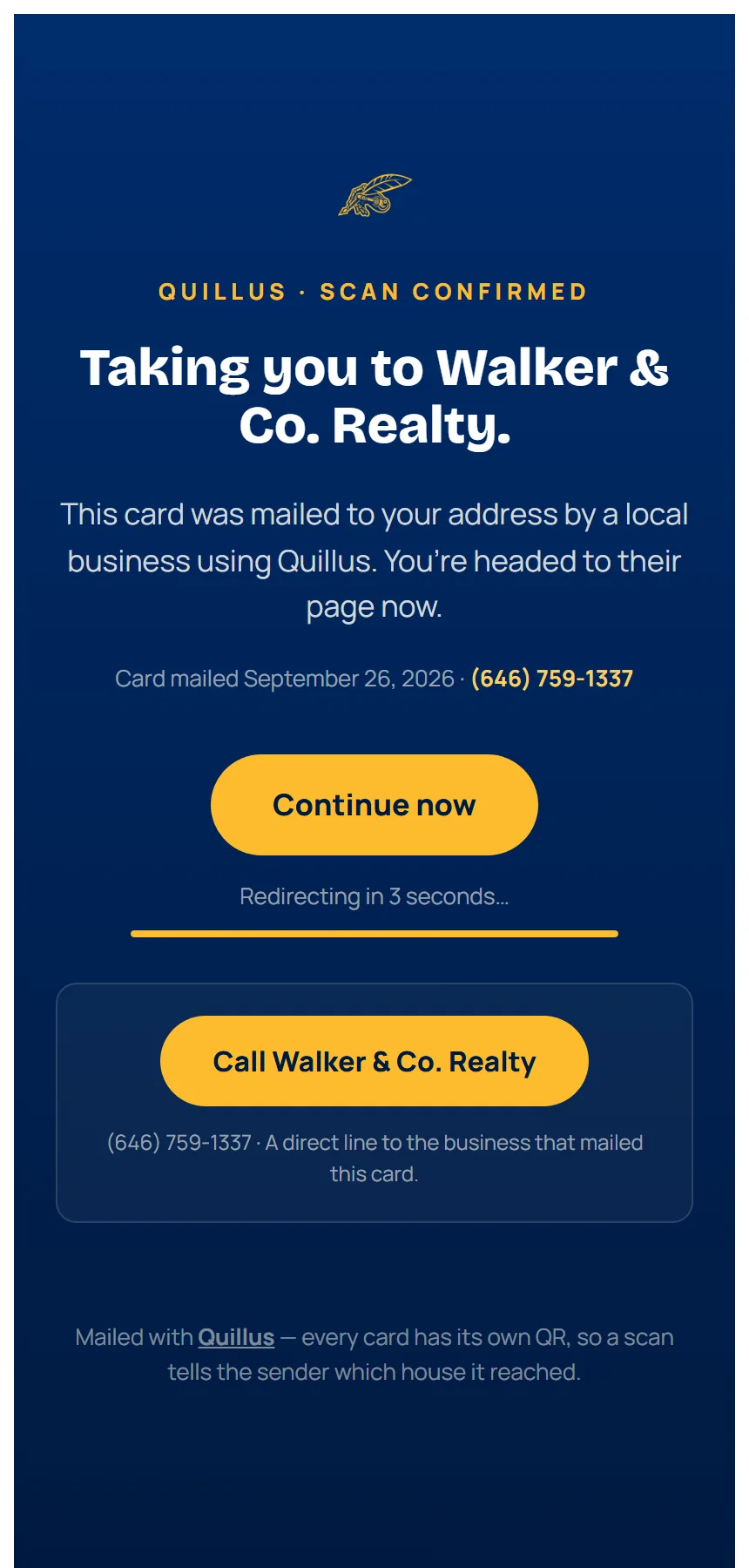
The neighbor scans. Their thumb is one tap from your phone.
Every card's QR opens a branded confirmation page with your number on it. One tap calls you, straight from the card. Then it forwards to your website. The lead reaches you while the card is still in their hand.
05 — Your book of business
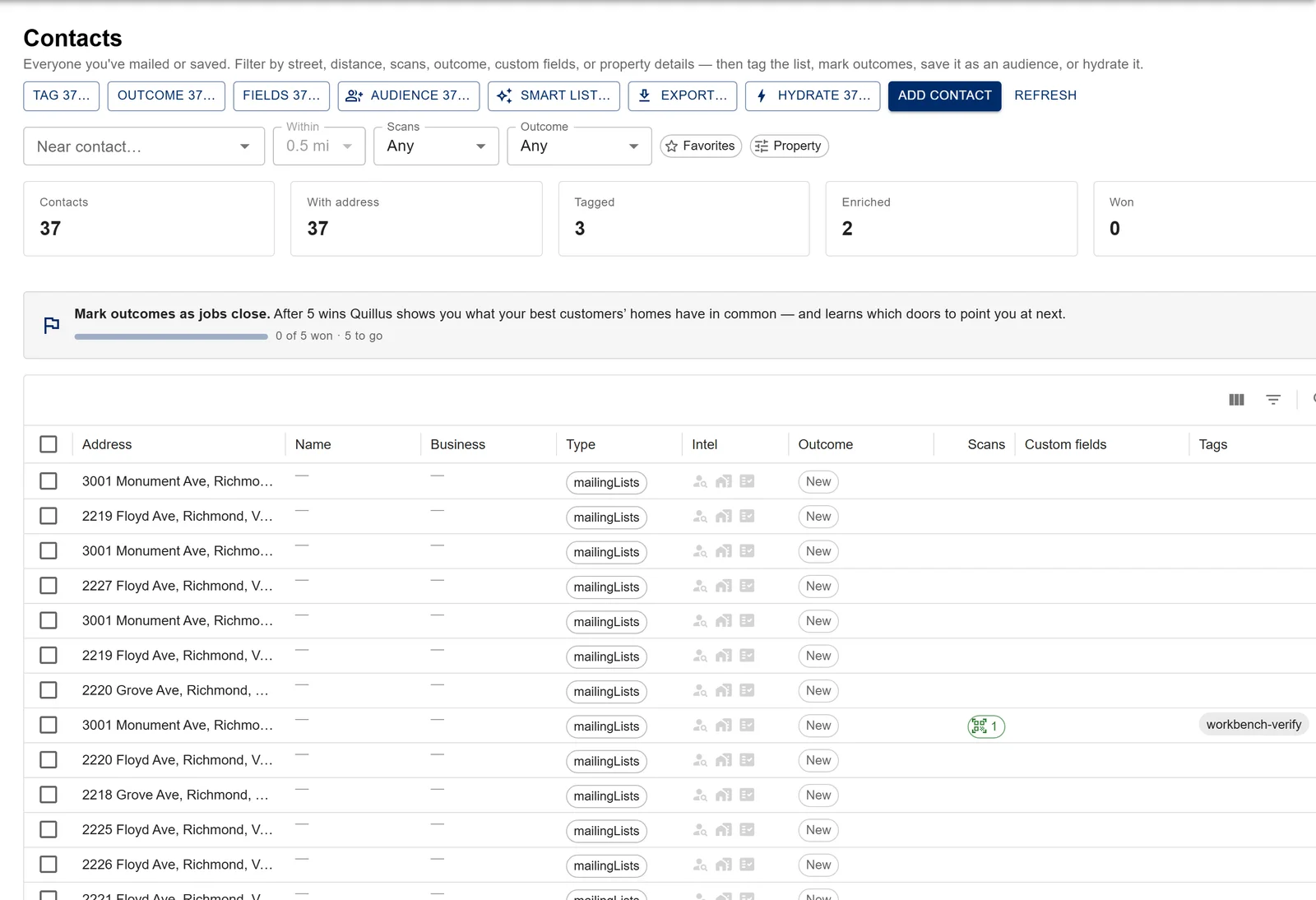
Every address you mail becomes a contact. The book builds itself.
Mail a street and every home on it lands in Contacts with what it received, whether it scanned, and the property intel behind the door. Tag them, filter by distance or outcome, save a list as an audience, export it. Mark five jobs won and Quillus shows you what your best customers' homes have in common.
What is Proximity Mail Marketing?
Proximity Mail Marketing (PMM) is direct-mail marketing in which each campaign is anchored to a completed job at a specific address and mailed to a fixed count of that address's nearest neighboring homes — typically the 100 nearest — rather than to a ZIP code, carrier route, or purchased list. The distance required to reach those homes is the campaign's proximity radius, the category's unit of measurement; each mail piece carries its own tracked response code, so results are measured per household rather than per campaign.
Quillus coined the term, and every campaign above is one: your finished job is the anchor, the 100 nearest mailboxes are the audience. Read the full definition or the research behind the category.
This is what it looks like when it works.
These results are coming. In the meantime, meet the founding family — they believe in the product.
The satellite view on the back is what got people calling. They saw their own roof and figured I already knew about it.
Quill's Bestie
Roofer · Akron, OH · (been saying 'bro, just try it' for months)Created a multi touch campaign for my best lawncare customers, and gave a discount to leave my sign on the lawn. I think we went viral on the street.
Quill W.
Landscaper · Cleveland, OH · (our first beta tester, allegedly)I used to throw $2K a month at online ads and pray. One Quillus campaign after a solar install paid for itself by the next week.
Quill's Mom
Solar installer · Columbus, OH · (she raised him right)Built for trades, not for marketers.
Everything you need to turn one job into the whole street. Nothing you don't.
About a week to the mailbox
Printed, addressed, and into the USPS mail stream within a couple of business days. First-class delivery after that — about a week from order to mailbox, where the rest of direct mail takes a month.
True proximity
The 100 physically closest homes — or one street, a route you draw, a school district, a ZIP. Never a list rented from a broker.
Satellite imagery
Each recipient sees their own roof on the card. Automatic, free, and included on every campaign.
Scout from the app
Pan Street View and satellite over every nearby home before you send a single card. Spot the oldest, most weathered roofs, favorite them, and aim your campaign where the work is.
Unique QR per card
Know which neighbor scanned, when, and from which address. Attribution that actually works.
Scans land on your site — and your phone
Every QR scan opens a page with a one-tap call to your line, then routes to your own website. Your branding, your landing, your lead.
12 templates — or design your own
Every card in your campaign can look different. Choose from our per-home image library, drop in your own job shots, or build a card from scratch in the designer.
No minimums
Send 100 today, send none tomorrow. No contracts, no monthly fees, no long-term commitment.
Built for trades
Roofers, solar, HVAC, electricians. The interface doesn't make you feel like you're filing taxes.
Pay per campaign. Pay per card. Never pay per month.
Start free. Send when you have a job to share. No commitments.
Starter
Try it on us
$0
One free demo card, mailed to your own address
Full demo and app access
See your real neighbors in live data
Per-card QR tracking
Per Job
No subscription, no minimums
$1.28
/ card
Big 6"×9" card — printing, postage, and mailing included
Send 5 or 500 cards — you pick the street
Satellite + Street View imagery of the real block
12 templates — or design your own from scratch
Per-card QR attribution dashboard
In mailboxes in about a week
EVERY CARD, EVERY TIME
One price. The good card.
No paper upgrades, no coating add-ons, no premium tier. The heavy, glossy, full-bleed card is the only card we print.
100–120# cover stock
Thick enough to stand up in the hand — not flyer paper.
UV gloss coating
Wet-look finish that survives a rainy mailbox.
Full bleed, edge to edge
Your photo runs off all four sides. No white border.
300 DPI print
Aerial and Street View imagery at true print resolution.
Unique QR per card
Every scan traced back to the exact house.
USPS First-Class
Real postage, real mail stream. Nothing bulk-rate about it.
Handwritten cards — real ballpoint pen, written by a robotic arm — are coming. Join the waitlist.
The questions every contractor asks first.
A full 100-home campaign runs about $128. That's 100 big 6"×9" cards on 100–120# cover stock with a UV gloss finish, printed full bleed, addressed, and mailed First-Class — no contract, no subscription, no minimums.
Cards are printed, addressed, and handed to USPS within a couple of business days. From there, standard first-class delivery applies — typically 2–5 days depending on distance. Plan on about a week from your order to the mailbox.
No. Pick a template, drop in a photo of your finished job, and you're done. Most users are ready to ship in under five minutes.
We geolocate the job site you enter, then pull the 100 physically closest mailable addresses. No ZIP-code shortcuts, no rented lists, no guessing.
The demo at the top pulls 20 real homes around any address you type, and every picture in "Inside the app" is a screenshot of the working product. The full map — hundreds of homes per pull, satellite and Street View, school-district and ZIP filters — sits behind a free sign-in with no card required. That sign-in is what lets us meter fairly and keep address scrapers out, so your neighbors' addresses stay with the local businesses that actually mail them.
No. Your customer's address anchors the geo search but is never printed on the cards you send. Recipients never learn who your customer was.
Yes. Upload a photo of the finished job, the crew, a before-and-after — whatever tells your story best.
None. Send one campaign and never send another. You're not on the hook for anything.
Every card has a unique QR code, so you'll see exactly how many neighbors scanned. If a campaign underperforms, we'll work with you on the next one.
More questions? Step-by-step guides for every screen live in the Help Center.
Your next job is on this street.
Try Quillus with your own address. See your real neighbors in live data. Mail yourself a free demo card — it lands in about a week, no credit card required.
Try the demo
Quillus
Proximity Mail Marketing for the trades. Built in O-H I-O. In mailboxes in about a week. Tracked per card.